
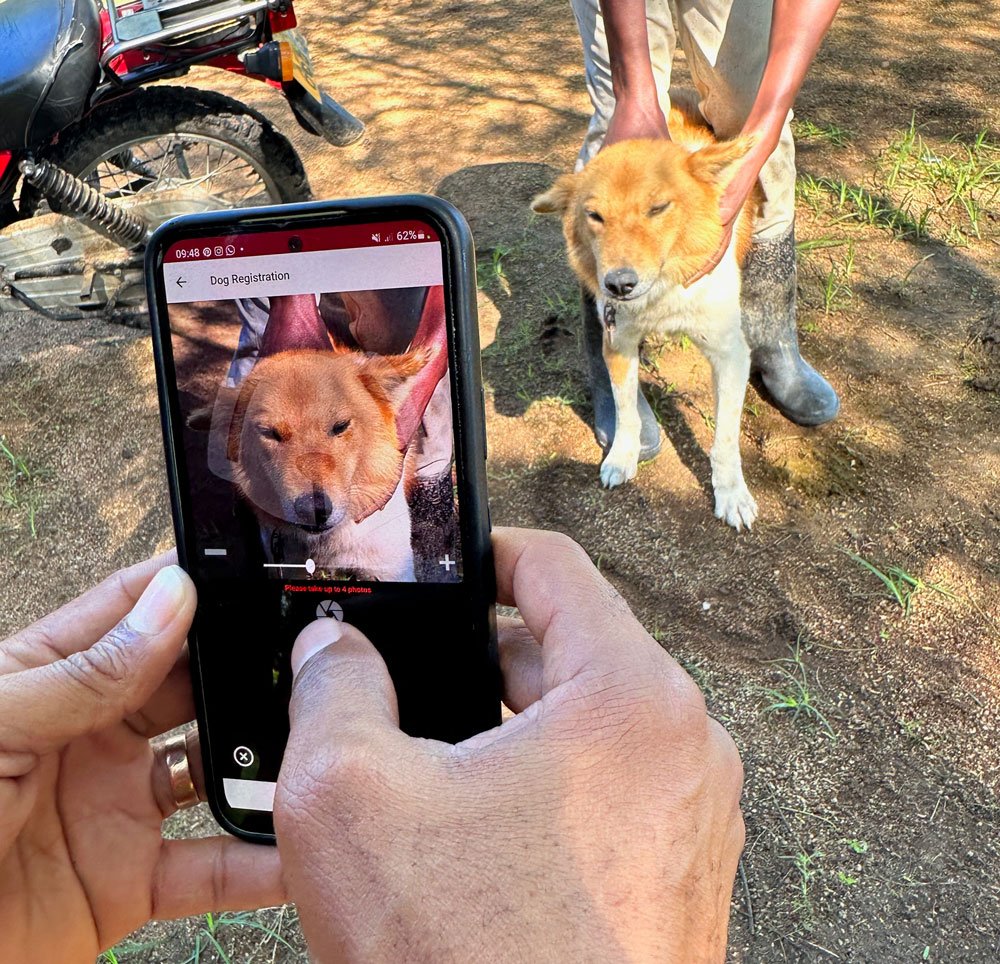
In collaboration with the PiP My Pet Technologies (PiP) (Vancouver, Canada) we are developing the world’s first facial recognition cellphone application to be used to identify dogs that have been vaccinated for rabies to assess vaccination coverage in rural areas in Tanzania. While the technology has been used in countries such as the USA and Canada to identify pets, this will be first time that the technology will be used in rabies endemic settings where dogs are commonly mixed breed.
Currently there are no cheap and accurate methods to accurately identify domestic animals, and this is a major barrier to zoonotic disease control programs in countries with limited resources. Existing technologies are either unreliable (e.g., ear-tagging and collars which can be removed and / or placed on other animals), are not sufficiently sensitive and specific (e.g., owner identification, certification), or are too expensive (e.g., microchips). This inability to identify domestic animals accurately and cheaply can impact program planning: for example, programs focusing on mass vaccination of domestic dogs to protect communities from canine-mediated human rabies are unable to accurately quantify vaccination coverage, and as a result identify areas of high disease transmission risk, with clear impacts on strategic planning.
The vaccination team will vaccinate dogs in six target villages and vaccinators will use the cellphone application to get a photograph of the face of each dog and biometric details such as gender, color of the dog and presence of scars and enter in the app. One month after vaccination activities have been completed, a research team will return to each target village to test using the FR technology, whether dogs have been vaccinated or not. The validation study will compare the sensitivity and specificity of the offline FR technology with the gold-standard animal marking technology (microchip) through a mass dog rabies vaccination campaign.
The PiP facial recognition technology uses an algorithm that can match animal faces using photographs. In addition to the image data, the algorithm uses the biometric data entered for each dog as filters to enhance accuracy. The FR engine will be set up to select the five closest ‘matches’ which the operator must examine to determine whether a true match has been found. The experience of PiP shows that this will be done with a high degree of accuracy. The matching process of all the images will be hosted by a group of trained individuals which will be held at GAHT office.
If successful, the FR can be adapted both for offline use and as a means of identifying domestic animals, an immediate application of this innovation will be found in human rabies endemic countries where mass dog vaccination efforts are being scaled up by national governments to meet the WHO ‘Zero by 30’ commitment of global elimination of human rabies.